A Complete Guide to Temperature Dependent Resistor Parts and Their Applications
Temperature dependent resistors are essential components in modern electronics, widely used for sensing, control, and protection. These components adjust their resistance based on temperature changes, making them highly valuable in applications where precise thermal monitoring is required.
What Are Temperature Dependent Resistors?
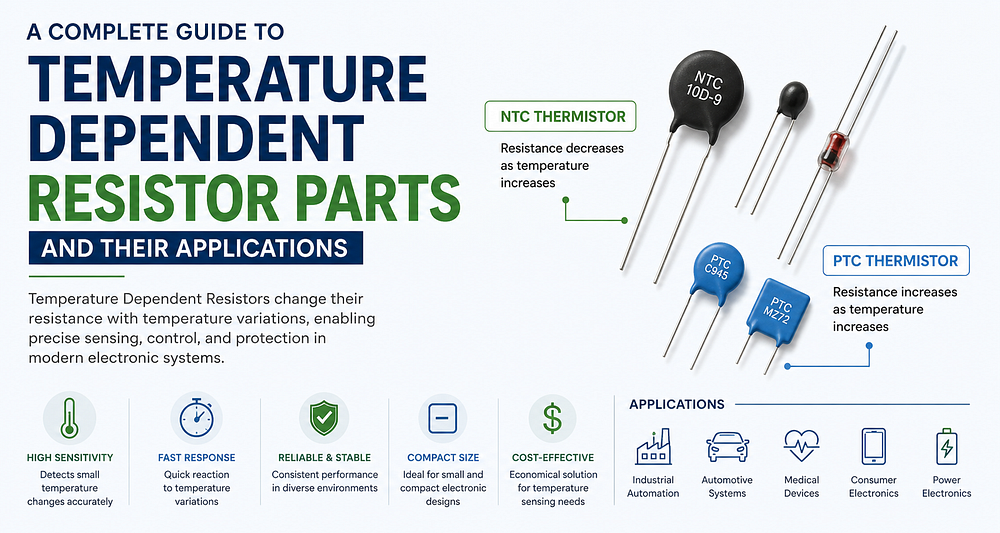
A Thermistor is a type of resistor whose resistance varies significantly with temperature. Unlike standard resistors, thermistors are designed to be highly sensitive to thermal changes, enabling accurate temperature measurement and control.
Types of Temperature Dependent Resistors
1. NTC Thermistors (Negative Temperature Coefficient)
- Resistance decreases as temperature increases
- Commonly used in temperature sensing and measurement
2. PTC Thermistors (Positive Temperature Coefficient)
- Resistance increases as temperature rises
- Often used for circuit protection and current limiting
How Temperature Dependent Resistors Work
Temperature dependent resistors operate by responding to changes in heat:
- Temperature Variation — Environmental or internal heat changes
- Resistance Change — The thermistor adjusts its resistance accordingly
- Signal Output — The change is measured and used for control or monitoring
This behavior is based on semiconductor properties that influence electrical resistance under varying temperatures.
Applications in Modern Electronics
Temperature dependent resistors are used across many industries:
Industrial Automation
- Temperature monitoring in machinery
- Process control systems
Automotive Systems
- Engine temperature sensing
- Battery management systems
Medical Devices
- Patient monitoring equipment
- Diagnostic systems
Consumer Electronics
- Smartphones, laptops, and home appliances
- Overheating protection circuits
Power Electronics
- Inrush current limiting
- Thermal protection in power supplies
Key Benefits
- High Sensitivity — Detect small temperature changes accurately
- Fast Response Time — Quick reaction to thermal variations
- Compact Size — Suitable for small electronic devices
- Cost-Effective — Affordable compared to other temperature sensors
- Reliable Performance — Stable operation in various environments
Key Considerations When Selecting Thermistor Parts
When choosing components from a parts database, consider:
- Resistance value at a reference temperature
- Temperature range
- Tolerance and accuracy
- Response time
- Packaging and mounting type
Role of Parts Databases
Temperature dependent resistor parts databases help users:
- Compare specifications easily
- Identify suitable components for specific applications
- Ensure compatibility and quality standards
- Streamline procurement processes
Conclusion
Temperature dependent resistor parts, commonly known as Thermistor, play a vital role in modern electronic systems. Their ability to respond to temperature changes makes them indispensable for sensing, protection, and control applications.
By understanding their types, working principles, and practical uses, engineers and buyers can select the right components to enhance performance, safety, and efficiency in electronic designs.


Comments
Post a Comment